
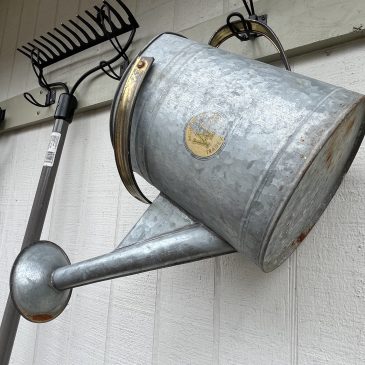
“Do you see the beauty of it all? … the different shapes and sizes … the purposes and personalities … the character and quality and backstories … and they’re ever so handy and accessible.”
That’s me chatting in my head (a left-brain, right-brain sort of thing). I’m discussing and reasoning and rationalizing a bit about why I now have all my gardening tools hanging along the outside walls of my little guest cottage that snuggles up behind my house.
I do think they look like wall art: the spade and the fork, the clippers and rakes, the hoe and hand broom and watering cans. In one corner there’s an old bent weathervane that couldn’t give directions in a hurricane. And to the left is a crusty canvas bag of pockets for hand tools and gloves and seeds and pieces of string. There’s one faded red umbrella.
On the ground beneath the hanging things, a bit tipsy and listing to one side, are stacks of empty flower pots – all sizes, some cracked, some chipped, some peeling. To me it’s a lovely kind of tribute mural. Art and memories and subtexts of nature and childhood – bare feet in the dirt, tomatoes warm from the vine, yellow butterflies.
In my mind, it was going to look like the inside of a well-appointed potting shed; but it really doesn’t. And I suspect many folks would see it as just a collection of old garden tools hanging on a slightly leaning cottage wall.
Admittedly, some of the tools are rather tired and worn and possibly outdated, with a few dents and scrapes, rough edges and flaking paint. Some had extensive field experience before they even came to work for me. But what I see when I look at them now is a sweet, soft patina of well-spent mornings and well-earned rewards.
It may be a little difficult to justify the common sense part of my wall hangings, because even though everything is mounted and placed well beneath a rather deep overhang of the roof, it’s definitely weather-exposed and the tools will undoubtedly reflect the ravages of the seasons over time. But that will just enrich the beauty of them in my eyes – adding compelling new rust patches and water marks and visual and tactile interest.
I rarely put these tools to work anymore. So perhaps this is their “retirement” place – their place and time to just hang out and let things happen. To become more artistic and intriguing. To be more worthy of appreciation, to just be enjoyed. And to be kept nearby like favorite friends – rather than hidden away in dark corners, forgotten in cabinets or cubbyholes.
I suspect, however, that part of the attraction I feel for these old garden tools is their obvious and inherent interconnectedness with the earth itself and all its living, breathing, growing things. Perhaps it’s their history of enabling new life and then nurturing it along the way. Some of the tools could have eased a burden of dirt and stones around the roots of a flowering fruit tree. Some might have offered nutrients and leg-room to newly planted pole beans. Some brought water to roses and ferns on thirsty summer days. Some snipped back stems and branches, encouraging new blossoms for bee feasts and butterfly respites. A few undoubtedly cleared off winter’s left-behinds to let spring once again have her way – even stirring up fresh opportunities for foraging birds and other hungry creatures.
I also suspect that these old garden tools speak to me of simpler times. Tools that connected us directly – our hands and feet and knees – with our earth and heritage and humanity. Unlike tools of today that are groomed to separate us from it all – from each other – perhaps even barring us from the possibility of return. My heart resonates with this thought of Herman Woulk’s: “It’s occurred to me that our human values, our ideas of right and wrong, good and bad, evolved in simpler times, before there were machines.” I suspect my old garden tools remind me of such a time. A time of a better us. And so I hang them on the outside of the cottage wall where I can see their beauty, and remember, and still have hope for us.