
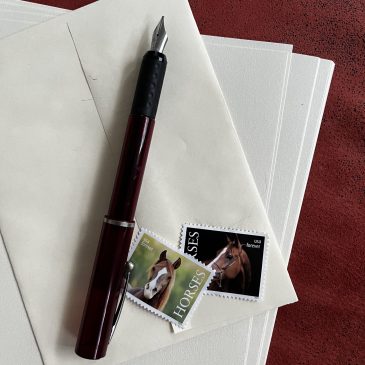
It wasn’t the first store. It was one of many. The young clerk was sincere. Sweet. Polite. Ernest. Stymied. So was the store manager to whom he was speaking on his headset. But when he asked me if I could describe to them exactly what I meant by “letter writing stationery,” I became rather alarmed. So … it had come to this. Here was the final disappearance of personal handwritten letters. We no longer as a society have the basic tools for writing them. The very paper upon which we used to write them was gone from the shelves – even from the language of our young.
There was a time when every corner drugstore carried boxes of letter-writing stationery – complete with matching envelopes. Typically in sets of 50 or 100 each. I remember the feel of the paper, rich and textured, thick like linen, watermarked, sometimes with deckle edges (I liked those best). And you had your choice from an array of colors. Starting at just $3.99 a box. They were the perfect Mother’s Day gift, or a young person’s first “grown up” present.
My mother had been a dedicated letter writer. Every week for as long as she was alive, every one of my siblings and I (unless we were physically under the same roof with her) received a letter. As did many others, family and friends alike. Every week, there it was in the mail box: a square blue envelope, addressed in blue fountain pen ink. And inside was a personal handwritten letter on matching blue stationery. And it was full of news and gossip, a great deal of nothing, and yet everything it needed to say. Just the glimpse of her small, cramped handwriting spoke to me as if she were reading the letter out loud in her own voice. I still miss it achingly. And so I decided to pick up the practice of letter writing myself.
The only paper I had on hand for my first letter was old and fusty, a faded cream, browning with age around the edges – but I used it anyway. I found a pen with brown ink and it smelled rather odd, but it went with the paper so I used it anyway, too.
But then it seemed to me that if I were going to continue to write my longhand pen-and-ink correspondence on paper, I must buy some proper letter-writing stationery. And so it began. I kept trying to explain to young helpful sales people what I was in search of. I drew diagrams and made hand gestures. And, occasionally, someone did know what I was looking for. But the best they could do was show me bound journals or packages of folded notecards or single-sheet cardstock for quick notes. After a fruitless search of the internet as well (a counterintuitive effort, I know) I had to accept that the days of such papers (at everyday prices) are, indeed, over. I’ve had to settle for 8.5 X 11 stock (which I could just trim down to my size). But I will continue to look for those matching square envelopes. And ink that doesn’t smell so regretful.
Because, more than ever, I am convinced that we desperately need to write and receive real letters. Authentic, handwritten letters. Long and lovingly written on pages and pages of real paper. We need to feel the scrape of the pen across the texture of the page. To think about and see the individual words as they emerge. Our recipients should know when something we started to say suddenly took a turn, or when we searched for a better way to tell them something, and so things got scratched out and replaced. They should see where our fingers couldn’t keep up, and we went back to fill in the gaps. We should be able to experience the thickness of the letter under our touch, folded into an envelope that doesn’t look like yet another piece of throwaway mail. Some of those square blue envelopes from my mother, with their blue ink and matching blue pages inside, may still be found at the backs of drawers or tucked between the pages of old books.
Consider, too, our next generations – the ones who are missing out on the gift of receiving a distinctive envelope in the mail every week for most of their lives, from someone who loves them out loud, with all the care and intimacy of handcrafted thoughts and feelings. And just the sight of it brings a smile to their hearts. And it can be saved and reread and pressed inside favorite books.
So here’s the assignment: Let’s bring it all back. Let’s – all of us – write letters, by hand, in script, on good paper. Let’s make them restock the shelves. Perhaps we could succeed in time for Christmas. In time for Mother’s Day. We can reclaim the art … the message … the generosity … the tradition … before it is lost.