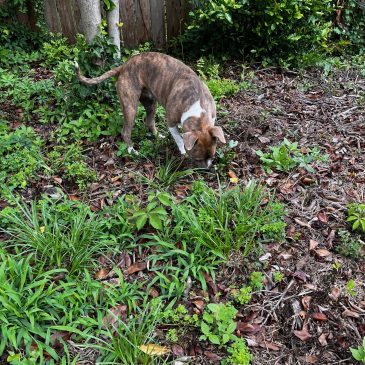
By my count, Daphne the dog has buried that pitiful old chew-bone at least five times – just within the last 15 minutes. Twice in the same spot. Now, she’s dug it up again and is carrying it around in her mouth, looking for another location in which to keep it safe. Even when she’s made the hole deep and wide, and covered it over with piles of dirt, and backed away apparently satisfied, she can’t keep her eyes off of it – the place where it waits. She paces past it, circles it. She lies down across the yard and gazes at it. Eventually, she can’t resist. She digs it up once more.
Now, she’s disappeared from my view. But I can smell fresh-turned soil nearby. So I know she’s preparing a new burial site for it, where it may lie-in-state for another few minutes. Only to be retrieved and worried over yet again. And here she comes … the filthy, degraded, mud-covered, mouth-soaked, pathetic old leather-like bone hanging from the corner of her jaw like a well-chewed cigar. And she skulks around the edges of the yard seeking out a new spot in which to keep and savor it.
I actually gave her that tired old chew-bone myself – knowing she’d likely do this with it. It was the same the last time she’d had one in her possession. And today she was bored and restless and looking for something to do, and I suspected this would occupy her, give her an activity, a self-defined purpose, something to focus on, then to obsess over, eventually to agonize about … until she chose to let it go. It’s become a proven process, some sort of ingrained ritual.
I suspect we are all inclined to do this very same thing at times. We find, create, uncover, define, seek out – or are given – something with which to over-occupy ourselves. Something to obsess about, to hold fast in our minds and imaginations. Something to agonize over. We captivate ourselves with it to the point of uncovering and revisiting it again and again in our thoughts and our actions – to exhaustion. Perhaps it is as ingrained in our humanity as it is with other creatures. Perhaps it is also a choice.
Because right over there … just on the other side of this self-made reality, just for the seeking and finding … is a place called “stillness.” More than silence, and not simple idleness, stillness is where all the good things live.
Whereas, “to hold still” is just an annoying verb – something we’re required to do as children in church or while getting our hair cut; to “keep still” is merely a handy thing to say when someone else wants to talk. But this thing called “stillness” – true, real, authentic stillness – is a place. A brilliant, breathtaking, breath-giving place.
Stillness involves our physical being as well as our senses. Stillness is our own breath inside us and a breeze sighing against our skin. Stillness is where we hear Debussy’s music between the notes, where stars fall and bubbles float and water lilies glide across paintings by Monet. It rustles along the ground and quivers across the tops of trees. It is butterfly wing shadows, and a bee suspended in sun motes. It’s the spin of a leaf, the smoothness of stone, the chill of a single drop of rain; it’s moonlight carrying echoes of foxes and the scent of jasmine on its back. Stillness is where small voices call to us with great truth.
I suspect this place called stillness may be easiest to visit alone and at night. Although our worry-bones seem to call out for obsession and agony most when we’re alone in the dark, as well. So perhaps it’s all a matter of where we choose to lie down. Or perhaps it’s where we decide to secure our reality.
Daphne has now opted to give her chew-bone back to me for safekeeping. She is trusting me to place it out of sight, out of scent, out of reach, out of worry. Now she is stretched out on soft grass, eyes dozing, in dappled sun. Resting, breathing, dreaming, being. Perhaps she is listening to small voices. I suspect she has, in her infinite dog wisdom, chosen to lie down in the peace of a place called stillness.